Here's a blistering T-Rex cover by Bauhaus- one of the best tracks they ever recorded.
December 10, 2013

December 9, 2013
The Velvets- Fragments of a History, Chapter 2: Peel Slowly & See

Simply put, The Velvet Underground's debut, The Velvet Underground & Nico, was a game-changer that, over the course of the four+ decades since its release, has served as a precursor to everything from glam-rock to punk to industrial and beyond, a deceptively unassuming album whose particular effect was best summed up in Brian Eno's famous pronouncement: "The first Velvet Underground album only sold 10,000 copies, but everyone who bought it formed a band." As the album cover suggests, the back-story of The Velvets' debut is very much about their brief stint as members of Andy Warhol's Factory, for it was through Warhol's mentoring and patronage that they were able to record (a now legendary) album that they themselves never thought would materialize. However, from the beginning of their association with Warhol, there was conflict. Paul Morrissey, an avant-garde filmmaker and factory regular, convinced Warhol that The Velvets needed a more appealing lead singer, as Lou Reed was prone to appearing withdrawn and abrasive on stage. German fashion model and fledgling singer Nico, whom Warhol had used in a few of his films, most notably Chelsea Girls, was Morrissey's recommendation to Warhol, who in turn set about convincing Reed and John Cale to accept Nico as the band's "chanteuse." Despite their initial resistance to the idea, Reed and Cale were eventually persuaded to not only accept Nico into the band, but to write a few songs specifically for her; being the intelligent opportunists that they were, they likely realized that being given new instruments, free rehearsal space, food, drugs, sex (of all kinds), and Warhol's pop-art cache were perks that few, if any, bands could ever dream of enjoying.
 Despite much evidence to the contrary, Sterling Morrison has suggested that the band was actually quite open to Nico's participation: "She was around because of Andy, but he couldn't talk us really into
anything. We thought it would be a good idea. I mean that's how the
whole thing was worked on the first album: The Velvet Underground and
Nico. In other words, we were a unit with or without her. And she could
do some things we really like, so we said do some songs. It was a
complicated working arrangement because she said if I don't sing, I
don't do anything. So it was always a question of how many songs Nico
would do, should she do all of them, which we didn't want, and that was
the only cumbersome aspect of it." Whether or not the band was initially receptive to Nico, her lack of musical experience had a divisive effect. At their first rehearsal with their new vocalist, the band reportedly
drowned her voice in guitar noise every time she tried to sing. As
Sterling Morrison has also revealed, after joining, Nico was often a detrimental force
within the band: "There were problems from the very beginning because
there were only so many songs that were appropriate for Nico, and she
wanted to sing them all [....] And she would try and do little sexual
politics things in the band. Whoever seemed to be having undue influence
on the course of events, you'd find Nico close by. So she went from Lou
to Cale, but neither of those affairs lasted very long."
Despite much evidence to the contrary, Sterling Morrison has suggested that the band was actually quite open to Nico's participation: "She was around because of Andy, but he couldn't talk us really into
anything. We thought it would be a good idea. I mean that's how the
whole thing was worked on the first album: The Velvet Underground and
Nico. In other words, we were a unit with or without her. And she could
do some things we really like, so we said do some songs. It was a
complicated working arrangement because she said if I don't sing, I
don't do anything. So it was always a question of how many songs Nico
would do, should she do all of them, which we didn't want, and that was
the only cumbersome aspect of it." Whether or not the band was initially receptive to Nico, her lack of musical experience had a divisive effect. At their first rehearsal with their new vocalist, the band reportedly
drowned her voice in guitar noise every time she tried to sing. As
Sterling Morrison has also revealed, after joining, Nico was often a detrimental force
within the band: "There were problems from the very beginning because
there were only so many songs that were appropriate for Nico, and she
wanted to sing them all [....] And she would try and do little sexual
politics things in the band. Whoever seemed to be having undue influence
on the course of events, you'd find Nico close by. So she went from Lou
to Cale, but neither of those affairs lasted very long."

December 8, 2013
The Velvet Underground - "Heroin" (1967)
An absolute fucking masterpiece, that one is. Part two of The Velvets series coming very soon...
December 7, 2013
The House of Love - "In a Room" (1990)
"There are lessons for the lonely,
When I'm drunk in a room,
that's when I think of you."
December 6, 2013
The 13th Floor Elevators - The Psychedelic Sounds of The 13th Floor Elevators (1966) / Easter Everywhere (1967) / Live (1968) / Bull of the Woods (1968)


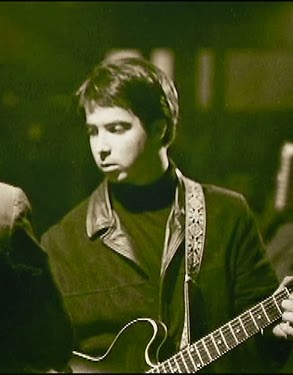 |
| Stacy Sutherland |
December 3, 2013
The 13th Floor Elevators - "You're Gonna Miss Me" (1966)
This mid-sixties Austin garage band, led by the legendary Roky Erickson and featuring the electrified jug playing of Tommy Hall, is pretty much ground zero for the psychedelic rock movement. But who came up with the idea of having them play a teeny-bopper pool party?
Love and Rockets - "No New Tale to Tell" (1987)
"When you're down, it's a long way up.
When you're up, it's a long way down.
It's all the same thing.
No new tale to tell."
Notes from the Paisley Underground: The Salvation Army - Happen Happened (1982/1992)

Michael Quercio was one of the pivotal figures of the paisley underground, not only because he gave the scene its moniker (which most, including himself, eventually came to hate because of its emphasis on image over musical substance), but also as the leader of The Salvation Army, a punky garage-pysch band who would later become the more overtly psychedelic and equally important Three O'Clock. If you're only familiar with the latter, then Happen Happened will come as something of a surprise because The Salvation Army had a much darker, grittier sound than the later, renamed version of the band, and the album itself happens to be one of the most vivid documents of the early days of the paisley scene in L.A., and some, including Rain Parade guitarist Matt Piucci, consider it the finest slice of neo-psych to emanate from the paisley underground. The origin of The Salvation Army begins with Quercio, then using the pseudonym Ricky Start, sending some home demos of his fledgling band in to Rodney Bingenheimer, the legendary Los Angeles-area disc jockey and unofficial curator of the growing alternative music scene that was soon to explode in the U.S. Inspired by Bingenheimer's enthusiasm for the band's sound, Quercio and band-mates Troy Howell and Johnny Blazing recorded a few professional-quality demos at a local studio, which ended up netting them their first big break. Quercio: "Our original 45 was released in the fall of 1981. We were all still in high school or just graduated. It was on the Minutemen’s label which was called New Alliance. There was a place where a lot of bands played called Alpine Village in Torrance that’s kind of like a German biergarten. Anyways, D. Boon from the Minutemen saw us there and after our show he came up and asked if we had anything and we had just made this little demo tape that we made with money we saved up from our parents and stuff. He liked two of the songs and said he wanted to put them out and he put them out on his label as a 45."
 |
| Michael Quercio |
December 1, 2013
The Three O'Clock- "With a Cantaloupe Girlfriend" (1982)
It's strange how something as seemingly innocuous as a video show can potentially change your life. My parent's had just been divorced, and now, living with my mom in a small apartment, completely isolated and without friends, I began to disintegrate into dust. One day, after school, flipping through channels on the TV, I discovered a video show called MV3. What was unusual about this show was that it focused mainly on alternative and independent artists, as it was hosted by, among others, local KROQ DJ Richard Blade. The American Bandstand-style dance sequences were often painful to watch, but over the course of the coming weeks and months, my ears and eyes were opened to the only music that had ever really spoken to me, music that told me I was not really alone and that being different was a sign of sanity, even in those moments when I felt like I was falling down the rabbit hole. This was the first time I discovered that music would always be there to save me. Another great aspect of the show was the live performances by local L.A. bands, many of whom comprised the paisley underground scene that was just hitting its stride at the time. Among these was an appearance by The Three O'Clock, which really made an impression on me at the time. However, I admit, the hosts are pretty lame, although I think I had a crush on the devotchka speaking at the end of the clip- what can I say? I was a kid, ha. Seriously though, I always wanted a cantaloupe girlfriend, but it took oh so long to find her......
p.s. this clip might have been the beginning of my love affair with red Rickenbacker guitars as well
p.s. this clip might have been the beginning of my love affair with red Rickenbacker guitars as well
Various Artists - CD86: 48 Tracks from the Birth of Indie Pop (2006)

"We [tried] to invent an alternative scene – our own version of punk you could say – by forcing a coterie of new bands onto a cassette called C86. It’s not entirely convincing and you should get out more if you remember The Shop Assistants – but it nails our colours to the mast. We, it said, for better or worse, are indie." -NME
One of the biggest misnomers about the UK music scene of the mid-to late 1980s is that nothing of interest was happening. Post-punk had gone pop, bands such as Echo & The Bunnymen and The Smiths were beginning to disintegrate due, at least in part, to the realities of major-label patronage, and the baggy beats of the Madchester scene were still a few years away. Reverberations of the punk revolution ten years earlier, though still audible, had been reduced to a murmur as D.I.Y. ideals had been replaced by glossy imitation. This was deep into the Thatcher era, meaning the deregulation of markets under the euphemistic title "economic liberalization", massive unemployment and social unrest. In the midst of all this, NME (New Musical Express), something like the UK equivalent to Rolling Stone, perhaps to stem its own slow descent into cultural obsolescence, made a fateful decision. NME journalist Roger Carr: "During the mid 80s, a few of us at the paper were starting to hear and see a load of bands coming through with a different sound to that which had dominated the independent scene for much of the earlier part of the decade. You got the feeling that something was happening, like the ground was shifting slightly." In an era long before the conspicuous consumption of digital music files, NME's issuing of a mail-order only mix-tape served as both an efficient way to expose new indie music to a larger audience and to resuscitate the publication's flagging indie credibility. Roger Carr: "We thought we'd do one of these for what was happening in indie music at the time. I'd done it for the paper before in 1981- the imaginatively titled C81- and that had been quite popular. So a few of us got together and started picking the bands we wanted to go on the tape." What this unassuming cassette tape would end up doing is become the catalyst for the rise of a new indie-pop scene whose influence would be as controversial as it was far-reaching.

Subscribe to:
Comments (Atom)